 DREAMLAND
Detail and size within each scenario
Each cell contains three independent saved worlds. A richly specified domain earned grade 3/3; useful coverage used grade ≥2. Size measures canonical world-only UTF-8 JSON bytes divided by 1,024. Larger files do not automatically imply better quality.
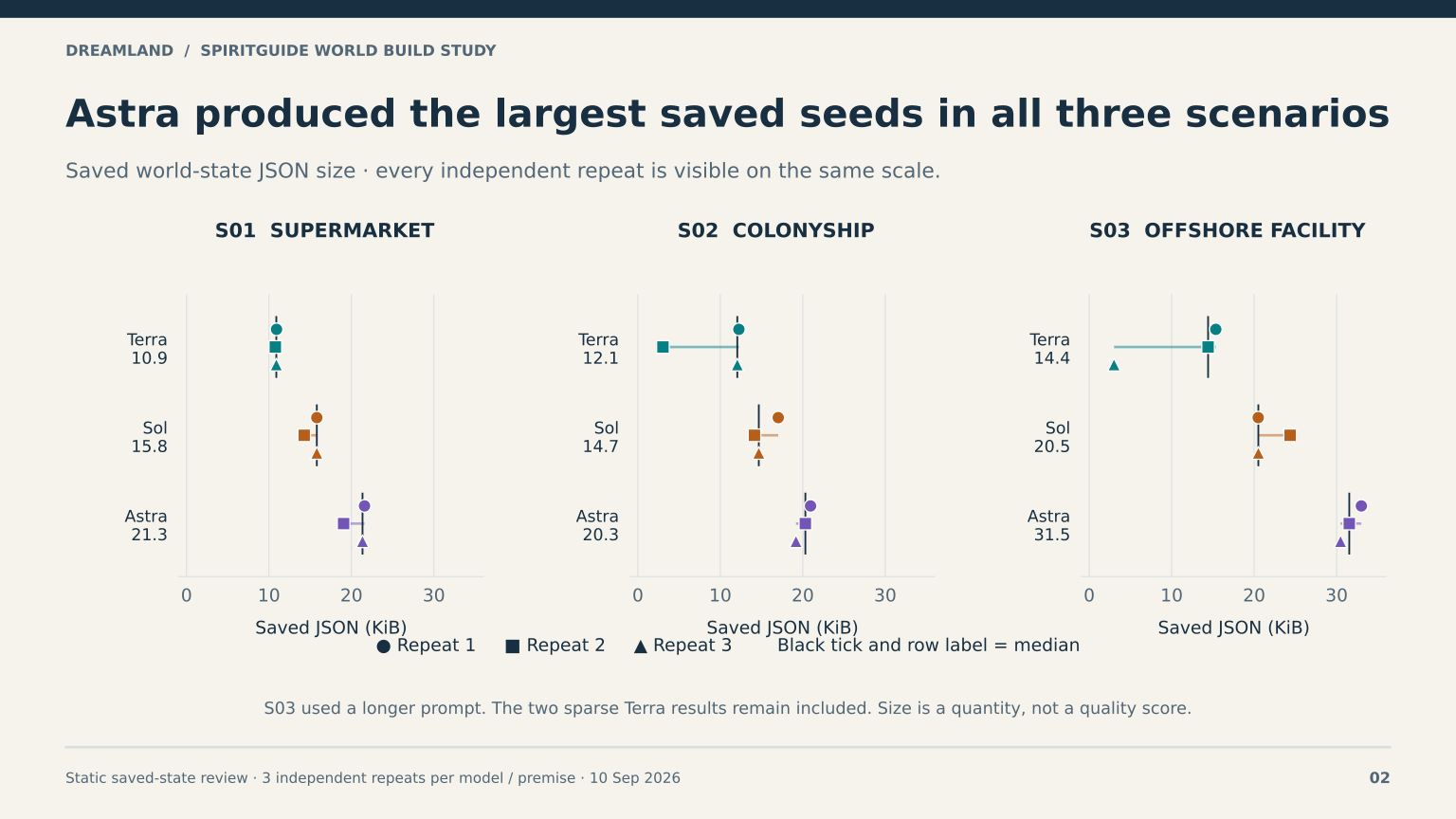
| Scenario | Model | Saved KiB | Rich domains /10 | Complete premise /3 |
|---|---|---|---|---|
| Supermarket | Terra | 10.89 [10.77–10.92] | 3 [3–3] | 2/3 |
| Supermarket | Sol | 15.80 [14.27–15.80] | 5 [5–5] | 2/3 |
| Supermarket | Astra | 21.34 [19.05–21.58] | 9 [9–9] | 2/3 |
| Colonyship | Terra | 12.06 [3.04–12.25] | 2 [0–2] | 1/3 |
| Colonyship | Sol | 14.67 [14.14–17.02] | 4 [4–5] | 1/3 |
| Colonyship | Astra | 20.31 [19.17–20.94] | 9 [9–9] | 2/3 |
| Offshore | Terra | 14.41 [3.01–15.35] | 3 [0–3] | 1/3 |
| Offshore | Sol | 20.51 [20.49–24.36] | 5 [3–6] | 3/3 |
| Offshore | Astra | 31.53 [30.48–33.00] | 9 [8–9] | 3/3 |
The checklists have five, six, and eight requirements respectively. Whole-premise completeness was 6/9 for supermarket, 4/9 for colonyship, and 7/9 for offshore. These different checklists do not form a pooled quality ranking.
Generation reliability and recorded cost
| Model | First-generation success | Calls | Failed generations | Recorded cost USD |
|---|---|---|---|---|
| Terra | 4/9 | 17 | 8 | $0.955866 |
| Sol | 9/9 | 9 | 0 | $1.785530 |
| Astra | 9/9 | 9 | 0 | $4.637790 |
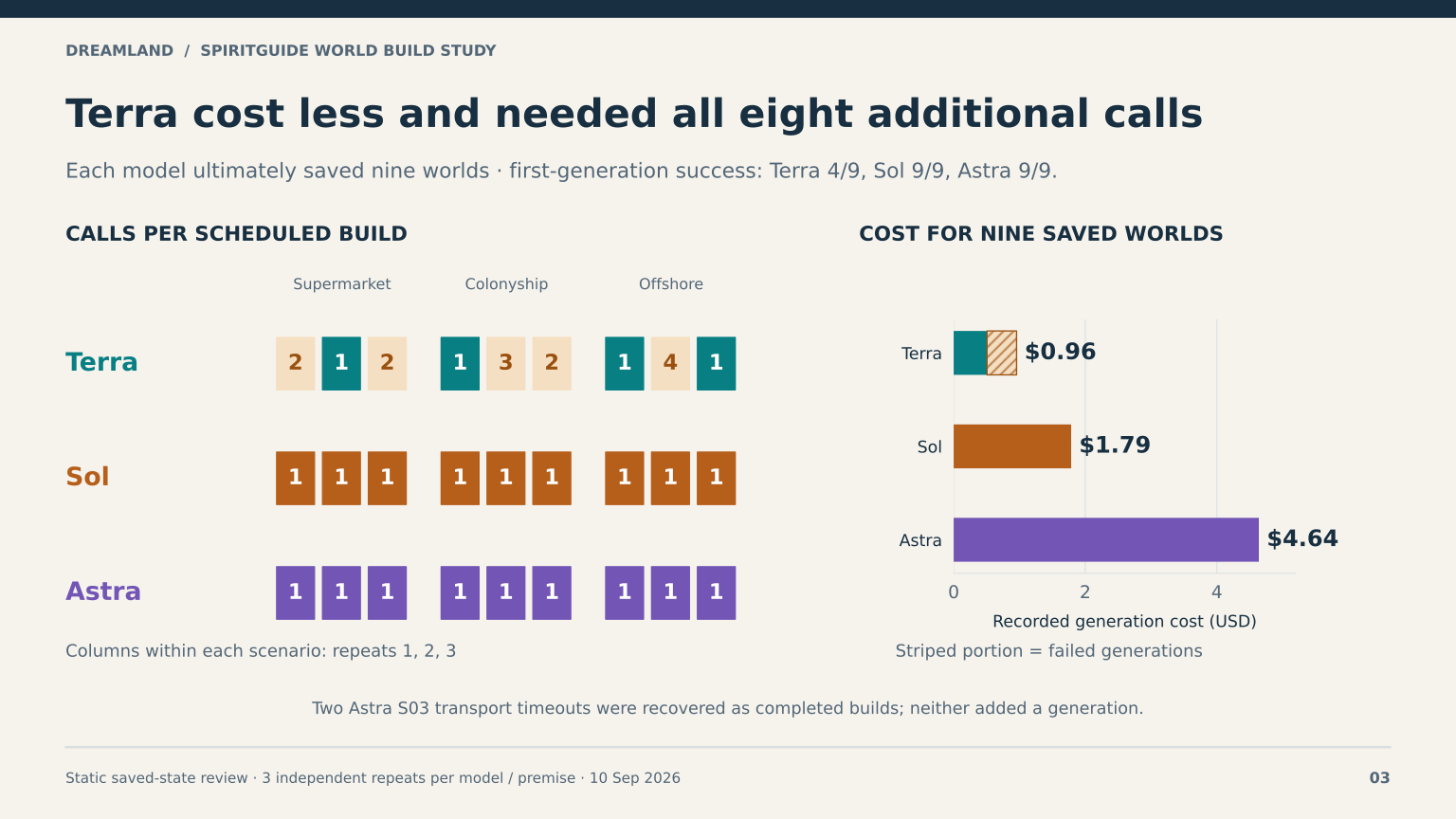
All 27 slots eventually produced a saved world. At most three additional attempts were allowed after a failure; the first structurally accepted world was retained, regardless of quality. Retries are not independent samples.
Two offshore Astra calls exceeded the MCP response wait but completed successfully. Same-trace evidence reconciled those completions without submitting duplicate generations; they are transport timeouts, not additional generation failures.
Two accepted saves lost important content
Colonyship, Terra repeat 2: the response put eight world facts and six expansion directives alongside world_state, rather than inside it. Processing ignored those misplaced registries. The saved world was 3.04 KiB, with zero world facts and expansion directives and an unresolved entry-site reference.
Offshore, Terra repeat 3: twelve facts and seven directives were similarly placed directly under state_update. The saved world was 3.01 KiB and supported only three of eight premise requirements in full.
Both results were graded as saved, without rerolling them for quality. These historical cases demonstrate why evaluation should compare raw proposals, processed updates, and saved artifacts. They do not establish the behavior of every later runtime revision.
A separate offshore projection audit found four omitted fact objects across three other worlds. Some content survived in other fields. Structural object losses are not equivalent to percentages of semantic meaning lost.
An expansive seed is not a running network
Every saved world had one materialized host. Only one of the 27 had a registered service; none had file or user registry members. Other systems, sites, workflows, and people were represented as named facts or concrete generation directions.
That distinction fits the just-in-time world-building approach: a seed can guide future exploration without prebuilding every machine and file. The study did not test whether the emulator would realize those directions correctly.
No confirmed internal contradictions were found in the reviewed saved scope; three issues remained unresolved. Sparse evidence and untested behavior limit what that finding can establish.
Measurements and provenance
Download the nine-cell measurement summary (CSV). It is recomputed from the preserved combined world and attempt tables, with failures included in generation costs. It omits private trace/session references and raw transcripts.
Figures reproduce the September 10, 2026 combined Spiritguide world-build study graphics without changing plotted data. Attribution: DREAMLAND contributors; CC BY 4.0. The public summary and tables introduce no new model calls or regrading.
Methods, rubric definitions, review exceptions, and evidence boundaries ↗