 DREAMLAND
The terminal is the interface. The world has its own state.
Can a language model sustain a believable computing environment as someone explores it, changes it, and returns to details they encountered earlier? DREAMLAND investigates that question through an explicit world state and an orchestrated simulation runtime.
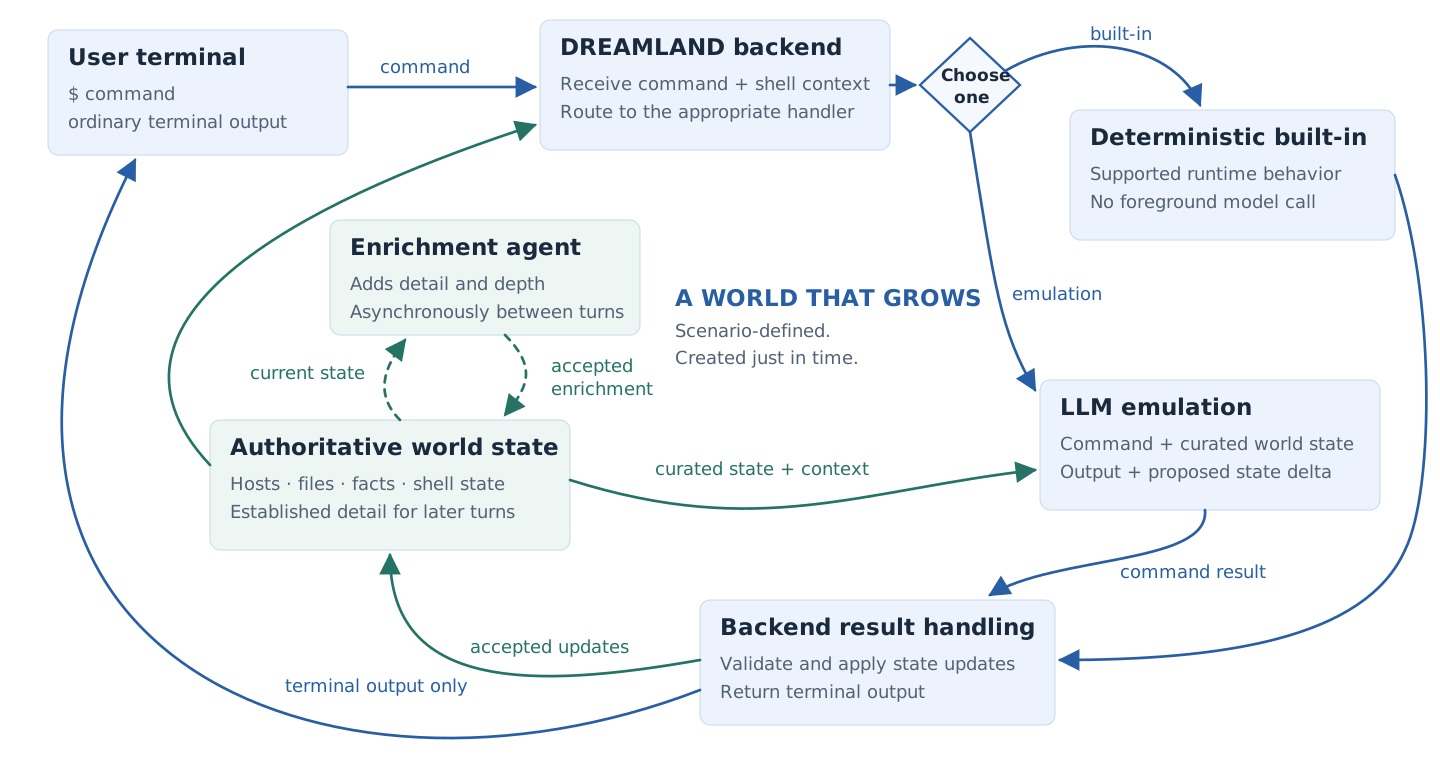
A real SSH transport handles the connection. Commands become structured simulation requests, with terminal output and state changes returned separately.
One command loop. Two execution paths.
Stateful emulation
A convincing response is only the start of the problem. Explore the mechanisms that carry an environment across commands, then consider how DREAMLAND admin guidance, background work, and evaluation change that picture.
Follow a command from real SSH input to a structured response and explicit world-state updates. Explore shell frames, host continuity, and the three depths of saved state.
Background enrichment
Early lightweight models could answer a command yet leave the surrounding system feeling sparse. Enrichment gave those same models focused expert tasks to build the missing depth. Explore why less context helped, how stronger models have changed its role, and where background agents could go next.
Spiritguide
See how a DREAMLAND admin authors worlds, revises a running session, or creates and forks saved profiles without an active user session.
API & MCP evaluation
Create isolated test sessions, control experimental variants, inspect state changes and failures, and keep restricted evaluators separate from trusted diagnostics.
Decisions behind the simulation
Each mechanism answers a concrete problem and introduces a tradeoff. Open a note to examine that choice.
01 Make important state explicit
Established facts need to survive subsequent commands. DREAMLAND separates terminal text from structured state updates, allowing the runtime to record and apply changes.
The tradeoff Coherence still depends on model behavior and the quality of the state contract.
02 Build detail as exploration continues
The DREAMLAND admin defines a setting without scripting every file. Foreground commands and background enrichment materialize further detail. Enrichment's default safe mode permits validated, bounded additions while preserving established state.
The tradeoff Background calls add provider cost and must coordinate with foreground changes.
03 Make persistence deliberate
Runtime worlds are isolated per session. A DREAMLAND admin can explicitly save selected state as a profile to use later.
The tradeoff A persistent world shared by multiple users needs additional identity, lifecycle, and conflict rules. It remains future work.
04 Keep the simulation inspectable
The DREAMLAND admin console and optional Langfuse tracing connect commands with model calls, state changes, failures, interruptions, and token usage. Session tracing notes explain how that record supports investigation.
The purpose These observations make it possible to investigate where the simulation holds together and where it breaks down.
When the model changes the design
Structured output, falling model costs, and faster serving tiers can change the reason a component exists. Enrichment and response handling need to be evaluated against the capability and price available now.